The Benefits of Switching to a Tankless Water Heater in Framingham
August 7, 2026
Quick Answer: Switching from a tank to a tankless water heater in Framingham gives you three concrete advantages: a wall-mounted unit that frees up an entire closet's worth of floor space, a system that only heats water on demand instead of keeping 40 to 50 gallons hot around the clock, and a continuous supply of hot water that doesn't run out mid-shower. The Department of Energy rates demand water heaters as 8% to 34% more energy efficient than storage tank models, and they typically last around 20 years compared to 10 to 12 years for a conventional tank. The one thing that matters in a New England climate like ours: Framingham's incoming groundwater runs much colder in winter than it does in warmer states, so correct sizing by someone who accounts for that seasonal swing is what actually determines whether you get the performance you're expecting.
Where the Water in Your Tank Has Been Sitting
A standard 40 or 50-gallon tank water heater does one job around the clock: it keeps a large volume of water hot, no matter whether anyone in the house is actually using it. The burner or heating element fires up periodically all day and all night, reheating water that's been sitting there losing heat through the tank walls. That's called standby loss, and it's the single biggest reason storage tanks use more energy than they need to. You're paying to keep water hot at 2 a.m. while you're asleep, just in case someone wants a shower.
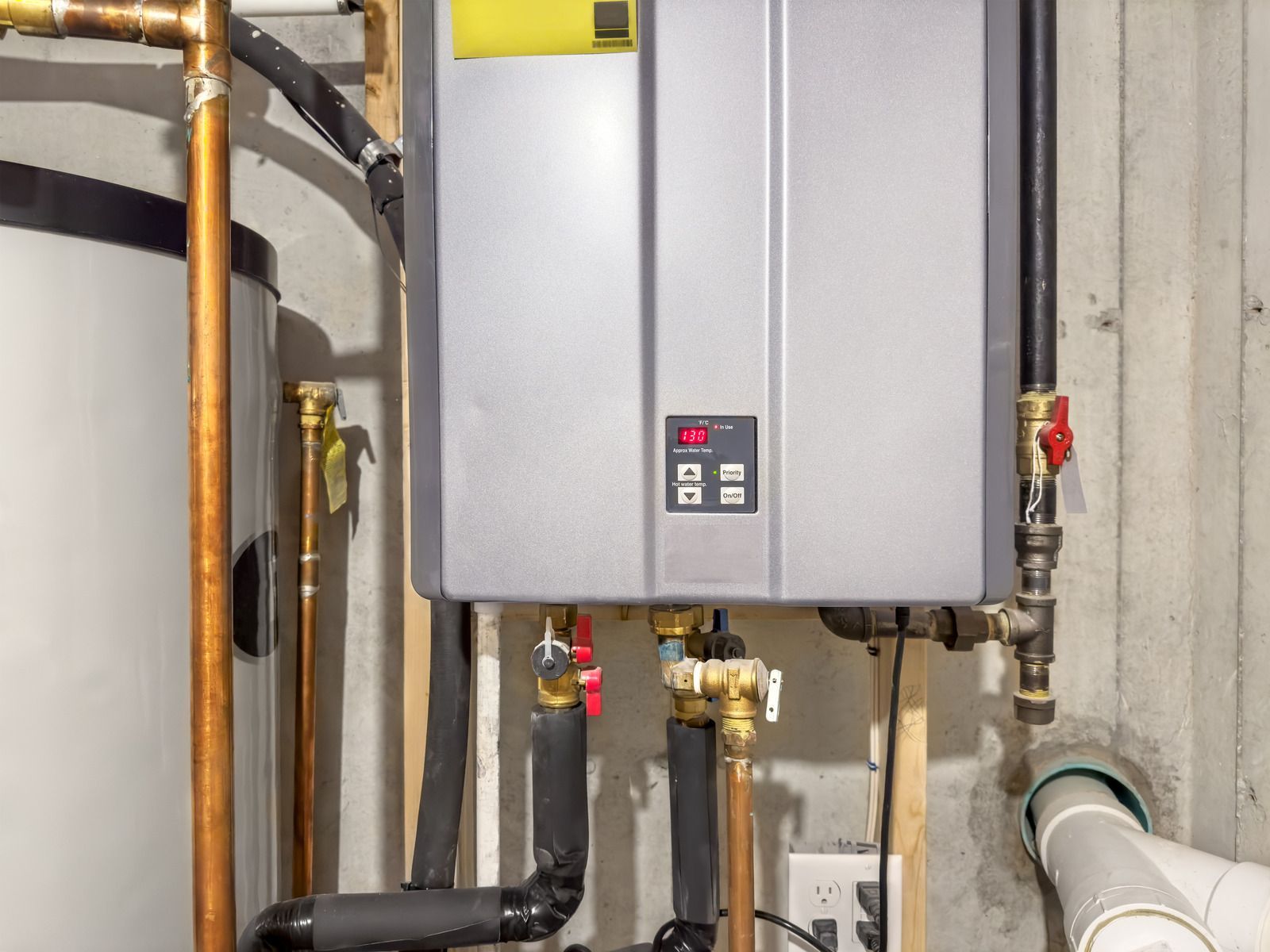
A tankless system skips that step entirely. Cold water runs through a compact heat exchanger only when a fixture calls for hot water, and the unit heats it in real time as it passes through. No standing reserve, no reheating cycle running in the background. That single design difference is why the Department of Energy rates demand water heaters as 8% to 34% more energy efficient than storage tank units, depending on how much hot water a household uses in a day.
The Space You Get Back
Walk into most Framingham basements or mechanical closets and you'll find a 4-foot cylinder taking up a corner that could otherwise hold shelving, a workbench, or just room to walk. Tankless units mount to a wall and typically measure about the size of a small suitcase. ENERGY STAR puts the space savings at roughly an extra closet's worth of room compared to a gas storage tank.
That matters more in older Framingham homes and Metro West triple-deckers than it might in a newer build with a sprawling basement.
Tight mechanical roomS
Homes built before the 1970s around here often have small, cramped utility spaces shared by a furnace, an electrical panel, and laundry equipment — losing a 4-foot cylinder from that mix opens up real working room.
Condo and townhouse installs
Smaller units without a full basement benefit even more, since a wall-mounted heater can go in a utility closet that would never fit a tank.
What "Reduced Energy Consumption" Actually Looks Like
Efficiency numbers on a spec sheet only mean something once you know what's driving them. Two things are happening inside a tankless unit that don't happen inside a tank.
First, there's no standby loss, which we already covered. Second, tankless units modulate. A tank either heats or it doesn't — full burner or nothing. A tankless unit adjusts its output based on how much hot water is flowing and how cold the incoming water is, so it's not burning more gas or drawing more electricity than the moment actually calls for. Run a single bathroom faucet and the unit fires at a fraction of its full capacity. Run two showers and a dishwasher at once, and it ramps up to match.
Tip: If lowering energy use is your main goal, ask your technician about a condensing tankless model. Condensing units capture additional heat from the exhaust gas before it leaves the unit, which pushes efficiency higher than a standard non-condensing tankless model — worth the conversation if this switch is partly about your utility footprint, not just space or supply.
Unlimited Hot Water, and the Catch New England Homeowners Should Know
Here's the part that sells most people on switching: a tankless unit doesn't run out. There's no 40-gallon limit sitting between you and the end of your shower. As long as water is flowing through the unit, it keeps heating it, for as long as you need.
But "unlimited" describes duration, not simultaneous capacity, and that distinction matters in a Framingham winter. A tankless heater's output is measured in gallons per minute at a given temperature rise, and temperature rise is the gap between your incoming water temperature and the hot water temperature you want. In a warm climate, incoming groundwater might sit in the 70s, which is an easy lift to 110 degrees. In Massachusetts, winter groundwater can run closer to 40 degrees, which means the same unit has to work through a much bigger temperature swing to hit that same 110-degree target. A tankless heater sized for a house in a warm climate typically needs to be roughly a third to half again as large to deliver the same simultaneous flow here.
Fewer Failures, Longer Service Life
Tank water heaters fail in a specific, unpleasant way: the tank itself corrodes from the inside out until it develops a pinhole leak, usually with little warning, sometimes flooding a basement or closet floor. A tankless unit has no standing reservoir to rust through, which removes that failure mode from the equation. ENERGY STAR lists a roughly 20-year life expectancy for tankless units, close to double the 10 to 12 years typical of a storage tank.
That longer service life comes with a maintenance trade — tankless units are more sensitive to mineral buildup inside the heat exchanger than a tank is, particularly in areas with harder water. A yearly descaling flush keeps the internal passages clear and the unit running at its rated efficiency. Skip it for several years and the unit has to work harder to hit the same temperature, which erodes some of the efficiency gain you switched for in the first place.
Warning: An undersized tankless unit is the single most common source of tankless disappointment, and it usually shows up as lukewarm water when a shower and the dishwasher run at the same time in January. This isn't a defect in the technology — it's a sizing mismatch that a proper load calculation, based on your actual winter groundwater temperature and your household's peak simultaneous demand, is built to prevent.
What Actually Changes During Installation
Swapping a tank for a tankless unit is not a like-for-like drop-in replacement, and it's worth knowing that going in. Gas-fired tankless units need a larger gas line in many cases, since they draw more BTUs at peak output than a tank does, along with venting designed for a tankless unit's exhaust rather than a standard tank flue. Electric tankless models often call for a dedicated high-amperage circuit, sometimes more than one, depending on the unit's output. None of this makes the switch complicated, but it does mean a technician needs to look at your actual gas supply, electrical panel capacity, and venting path before quoting the job, not just swap boxes.
Condensing tankless units add one more wrinkle worth knowing about: they produce acidic condensate as a byproduct of pulling extra heat from the exhaust, and that condensate needs a proper drain line and, in most installs, a neutralizer to protect the pipe it drains into. It's a small addition to the job, but it's one more reason the swap gets planned around your specific mechanical room rather than treated as an off-the-shelf swap. Most installations, once the gas, electrical, and venting work is scoped out ahead of time, finish in a single day.
Frequently Asked Questions
Is a tankless water heater a good fit for a full family home in Framingham, or just smaller households?
Tankless works for full households, including families running multiple showers, a dishwasher, and washing machine together. Correct sizing for peak simultaneous demand and winter groundwater temperature matters most, sometimes requiring two units for busy mornings.
Do I need to switch from tank to tankless during a specific season?
No, installation happens year-round, though scheduling before winter avoids troubleshooting sizing or performance questions during the coldest groundwater stretch. Installing during a milder month lets you see how the unit performs before temperatures swing extreme.
Can I keep my existing gas line and venting when switching to tankless?
Sometimes, but often not. Tankless units draw more gas at peak output and vent differently, so a technician must check your gas line diameter, meter capacity, and venting path before assuming anything transfers over unchanged.
How much colder is Framingham groundwater in winter compared to summer?
Groundwater temperature swings noticeably by season in Massachusetts, running much colder in winter than summer. That's why a unit sized for summer performance can underdeliver in January, since sizing must account for the coldest point.
Does switching to tankless mean I'll never run out of hot water no matter how many fixtures run at once?
Not quite — a tankless unit heats water continuously rather than running out, but every model has a maximum flow rate at a given temperature rise. Push past that rate and the output temperature simply drops.
Do tankless water heaters need more maintenance than a tank?
They need different maintenance, not more. A yearly descaling flush clears mineral buildup from the heat exchanger, and it matters more for tankless units since scale buildup directly reduces efficiency and flow rate over time.
Why Framingham Homeowners Are Making the Switch to Tankless
Choosing between a tank and a tankless water heater comes down to what matters most in your home: reclaimed space, lower energy bills, or hot water that never quits mid-shower. In Framingham's climate, the real difference-maker is sizing that accounts for how cold groundwater gets in January, not just square footage or upfront cost. Get that calculation right, and a tankless system delivers on every one of its promises, season after season, without the guesswork.
With 10
years of experience serving Framingham, MA, Harbor Home Services
has seen firsthand how the right-sized tankless unit transforms a home's mechanical room and utility bills alike. We look at your gas line, electrical panel, and winter groundwater conditions before recommending anything, because a system built around your actual household holds up long after the installation crew leaves. That's the difference between a upgrade that disappoints and one that quietly does its job for twenty years.